Tuesday, February 26, 2008

Slate's Wire Club gets worse and worse (WARNING: If you're not caught up, there's a spoiler below. I don't know if I can protect you forever, but I'm trying for now). I don't know how Jeff Greenberg does it. He seems to understand the show even less when he actually likes an episode. And David Plotz, whose Blogging the Bible series was one of last year's sleeper delights, seems only marginally more aware of what's going on in this series. It's like reading 6th graders on Moby-Dick. They've put names to the major characters, but seem baffled anything on-screen requiring a subtle read.

Consider Jeff Greenberg's question about what's presumably Omar's final scene in the show:


One more question, suggested to us by our maximum leader: What was the point of seeing Omar laid out in the morgue, victimized one final time, in this instance by a city bureaucrat? If it was to prove the point that the city doesn't work, well, I think the point has been made. Or was it just to allow the audience to mourn? Or get a fleeting glimpse of Omar's groin?


Wow. I get where a casual observation of the show might confuse a viewer about what happened in the morgue, which was this: The medical examiner opened Omar's bodybag just around the head. Then the medical examiner opened the next one, revealing the head of an older white man. The medical examiner looked at the ID card for the white guy and read that it was for Omar, a black man (DOB listed as 1960, so obviously the system has bad info on Omar, who was born in the early to mid 70s). Smiling a little at the mistake, the medical examiner switches the cards, which will ensure that Omar is buried under his own name. There's a naked, overweight, Black body in the background throughout this scene. Any fleeting glimpses at groins would be at this unnamed and unknown prop. So, a casual viewer might misunderstand what happened there. But seriously? If you're a columnist writing about a show for a major national magazine, watch the fucking thing twice. And do it carefully, not while you're thinking about how you're going to justify your support for Bush's invasion of Iran or something. Fucking lazy-ass jackhole. (As you may read in comments, Anonymous calls me out on resorting to lazy profanity when my point is better made without it. But I'm nothing without my warts and all, so I'm both striking it and leaving it readable. Anyway, sorry for calling names. "Lazy" was probably strong enough.)

Here's another stellar insight:

You haven't convinced me on Carcetti—I believe the man still wants to do good, which is why he's so interesting as a character, in a way that his predecessor in office wasn't. But you've half-convinced me on Marlo. I see your point—Marlo needs to be left standing in order to make a very important point about the futility of the drug war, among other things. And if The Wire doesn't give Bunk a victory, then I'm canceling HBO. Unless The Wire has become just irretrievably dark, I can't imagine a situation in which Chris escapes Bunk's DNA evidence, and since there's no escape, there's little chance Chris will overthrow Marlo before Bunk closes in. Of course, Chris could knock off Marlo and then Bunk could knock off Chris, but then it's a happy ending, and I don't imagine we'll be having one of those. Of course, if McNulty is allowed to die in a pool of his own vomit, or if Lester accidentally overdoses on dollhouse glue, or Bubbles becomes a heartless schmuck, then I suppose the show could safely kill off Marlo without anyone accusing David Simon of staging a cheap morality play.

I don't get how Greenberg could be so simple-minded. Doesn't it seem exactly the point of Carcetti that his belief in what he says is complete and total and lasts only as long as he is saying these things? Greenberg's a reporter covering politics in Washington DC, right? Is the inability to understand this basic fact about successful politicians a prerequisite for that job? And let's go on. Greenberg says that Marlo needs to be left standing to prove a point about the drug war and then goes on to speculate about a power struggle between Partlow and Marlo and how to get to a happy ending, basically involving the deaths of major characters where Greenberg's little internal morality-ometer has flipped in recent episodes. Then he suggests that if these things happen, David Simon is NOT staging a "cheap morality play." I get that he's being sarcastic about how he feels about the show, but that final judgment isn't sarcastic, but practically a demand that Simon's Baltimore be a cheap morality play where the good guys are punished when they stray from the straight and narrow.

Which, in my opinion, misses the entire point of the fucking show, let alone any artform of the last, say, 200 years that requires the audience to consider ambiguity. When I started off reading the Wire Club, I thought it unforgiveable that these gasbags who clearly don't think much of the show get paid to bullshit in public about their limited understanding. Now I sorta think Greenberg in particular has shown that he doesn't have the critical thinking necessary to perform his primary job as a political reporter and commenter. Maybe he would be better as a TV reporter, covering fictions without a hint of ambiguity. He could be one of those inexplicable writers who write glowing tributes to "Two and A Half Men" and reflect fondly on "Everybody Loves Raymond."

Tuesday, February 19, 2008

After getting over the flu, I had a sinus infection for another week. So February has not been a big post month for me. I have several books to review, and I want to mention some recent movie viewings, too. All coming to this blog when I have time! In the meantime, I wrote about artists influenced by Richard Thompson at the Shoot Out The Lights blog.

Saturday, February 09, 2008

I've had the flu for the last week, five days & six nights of aching, chilly, fevery, snotty misery.
The upside is that I slept approximately 70% of it. The downside was being awake occasionally.

Anyway, I have several books to review, but I'm not up to it yet. In the meantime, you should read Leonard's dispatches from the Conservative Political Action Conference because he is braver than you or I and his tolerance for bullshit is profound.

The Beast Is Red

Chapter 1: An American God

Chapter 2: Invisible Asia

Chapter 3: You Shan't Go Home Again

Chapter 4: In a Mad Frenzy, Stinging Themselves to Eternal Death


Chapter 5: Soy un Perdidor

Chapter 6: She Don't Like, She Don't Like, She Don't Like...McCain

Chapter 7: Holding a Shard of Mirror Up to Nature's Throat

Chapter 8: Twice Presented Him a Kingly Crown

Chapter 9: Brought Me to Darkness, But Not Into Light

Chapter 10: The Sugar and the Shit

Chapter 11: Pestilence Goes for the Big Laff

Chapter 12: Show Us Your Twits

Chapter 13: Getaway

Wednesday, January 30, 2008

I'm still reading Against The Day, but I wanted to mention this Pynchon-like myspace artist.

Hans Groiner Plays Monk

From the description:

I am originally from the Austrian village of Braunau, (also the birthplace of Hitler, but please don't hold that against me!). I started playing accordion, then piano, from a very young age. My other hobby was listening to the radio. One day, around 1978, I heard a very interesting piece of music that turned out to be a jazz pianist named Thelonious Monk. It pickled my interest because it was very different from anything I had ever heard. Although his music fascinated me, I had very mixed feelings. On the one hand, Mr. Monk had obvious talents, but on the other hand, his piano playing was very messy, and his songs had many funny notes and rhythms. Over the many years that I have been studying his music, I have grown to the conclusion that his songs would be much better, and much more popular, if many of the dissonances, or "wrong notes," were removed. With my new CD, "Hans Groiner Plays Monk," I have done just that.


Awesome! Maybe he'll get to Cecil Taylor and Peter Brötzmann next!

Book 3/50: Harry Potter and the Half-Blood Prince by J.K. Rowling


Yes, it's been out for a while and yes, it's a book for children. I read the first four books in the series a number of years ago and figured I was done with it then. But my brother has prevailed on me to finish the series, saying that it gets better and even addresses the exceptionalist way that Harry Potter is wonderful at everything and everyone good loves him and all that. I don't mind those things for the story - after all, the books are meant for children, and children sometimes need a less complicated main character to identify with - but it was getting tedious for me. So, long story long, I figured I'd read the final three books.

And that's all justification for reading books that are, after all, a pop culture phenomenon, so here's the skinny. I read Harry Potter and the Order of the Phoenix back in October or November of last year, and my brother was right: the books were a bit more nuanced and interesting. I bought this one recently and read it in about two days (I mean, it's the size of a phone book, yes, but the font is huge and the story is all plot, which is easier to read than good writing, y'know). Other reviewers have exhausted everything there is to say about the book, so all I'm going to add is that it's ok. I'm glad I'm reading it, but it's basically junk food. I like Oreos, too, but I'm not going to praise them for their complexity or rewarding experience.

Tuesday, January 22, 2008

Book 2/50: The Amalgamation Polka by Stephen Wright


I should say more about this, but I've been sitting on this review for over a week. The novel is about the U.S.'s attempt to heal over the scar of slavery before and during the Civil War, and it combines some harrowing realistic segments (such as the battle sequence, Antietam, I think) with highly allegorical characters and situations. There's a few spoilers below, but nothing that should dampen your enjoyment of this novel.

The main character is Liberty Fish, the son of New York-based abolitionists, although his mother grew up on a slave-owning plantation in South Carolina. When she left, she never saw her parents or siblings again, but their hold on her (often amplified by their letters) hurts her terribly. Liberty heads off to war when it breaks out, but eventually deserts from Sherman's March to go meet his maternal grandparents, only partially prepared but determined to witness the Boschian horrors of the plantation.

Wright's eye for historical detail is thrilling. For instance, the segment of the book in which a young Liberty and his father travel by boat upriver along the Erie Canal (or is it the Niagara River?) reminds me of both Melville's The Confidence Man and Vigo's excellent movie L'Atalante, but it is also very different and true to the central conflict of his story. I think those expecting pure realism will be lost, but readers who enjoy woozy surrealism (it's not for nothing that Pynchon himself has a blurb on the cover) would very much enjoy this novel.

Wednesday, January 16, 2008

A couple of links to mention.

Leonard's World War Livingroom project is a sight to behold, so go behold it.

33 1/3 blog has an excerpt of my forthcoming novella/music criticism. I'm not going to insist you go read it, but there it is. As always, news about said work can be found at the Shoot Out The Lights blog.

Tuesday, January 15, 2008

I'm-a gonna read 50 books in 2008! Maybe!

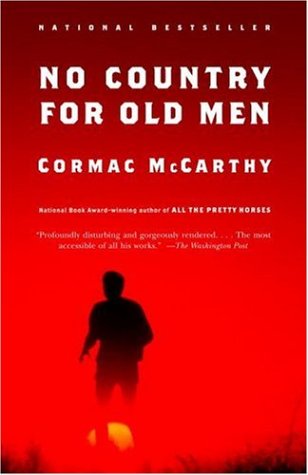
Here's book No. 1/50: Cormac McCarthy's No Country For Old Men

I love Cormac McCarthy, as a general rule. I think Blood Meridian, Suttree, and The Road are among the finest novels of the last 40 years. But I'd heard other McCarthy lovers express indifference for much of his post-Blood Meridian work, and a reading of All The Pretty Horses a few years back seemed to confirm that take on the man's oeuvre. I thought as much as I loved his major works, maybe his minor ones weren't for me.

Then I saw the Coen Brothers' big screen adaptation of No Country For Old Men a couple of weeks back, and I figured that I should give the book a try. The movie spoke to me. I thought the book would, too.

And it does, but it's not the same. All my mental images have been pre-determined by the movie. Even where the book and movie diverge (which isn't often), I have a hard time picturing the scene without a stylistic similarity to the Coen Brothers' movie.

Anyway, yes, the book is pulpier and thinner than McCarthy's major works. The themes of inevitability and the rotten heart of human existence are on better display in other McCarthy books. Moss and Sheriff Bell could be Larry Brown creations. They are suitably rough and driven by internal monologues that aren't necessarily shared with the world (or readers, in Moss's case), but they lack the mythic otherness of McCarthy's best characters, although Chigurh certainly makes up for that.

It's a quick read, though. Because I saw the movie first - and because I think the movie is the superior work in this case - I'll never think of it on its own. I'm pretty sure it will always be a companion to the movie in my head.

My photo
Cary, NC, United States
reachable at firstname lastname (all run together) at gmail dot com

About This Blog

From Here To Obscurity, founded ca. 2003, population 1. The management wishes to emphasize that no promises vis-a-vis your entertainment have been guaranteed and for all intents and purposes, intimations of enlightenment fall under the legal definition of entertainment. No refunds shall be given nor will requests be honored. Although some may ask, we have no intention of beginning again.

  © Blogger templates Brooklyn by Ourblogtemplates.com 2008

Back to TOP