Thursday, July 16, 2009

Music Library: Dream Syndicate, Drink Me, Drive-By Truckers, Drivin' N' Cryin', Duane Allman, Duke Ellington, Dukes of Stratosphear, Dump, Dungen


The Dream Syndicate - The Dream Syndicate EP (1982), Medicine Show (1984), and It's Too Late To Stop Now (1989). The EP is a great slice of VU-inspired rock, but Medicine Show is so marred by crappy 1980s "this is college rock" production that I could barely listen to it. The last one (sharing its name with a Van Morrison live album) is a collection of demos and live tracks from after the band broke up, and I like it much better than Medicine Show.

Drink Me - "St. Monday." Trumpet-driven melancholia. This was almost certainly off of a mix tape at some point.

The Drive-By Truckers - Gangstabilly (1998), Pizza Deliverance (1999), Southern Rock Opera (2001), and A Blessing And A Curse (2006). I have mixed feelings about the DBT. On one hand, I find myself quite moved by the stories, especially when Patterson Hood sings (and "Let There Be Rock" off of Southern Rock Opera may be one of my favorite songs by anyone), but on the other hand, their attempt to keep the sound very much in the major-key classic rock tradition leads to a lot of similar-sounding music. Some tracks rise above, and some seem stillborn, but most hang out in the middle, hard to distinguish from each other. On A Blessing And A Curse, the DBT honed their edge right off and made a lot of middling music. I don't have any of the other albums with Jason Isbell on them, but I hate his blue-eyed soul voice and the Bon Jovi production on his songs, which by itself would make this album my least-favorite, but even Hood and Mike Cooley sound like they're trying to write music for Clear Channel on this album. Makes me afraid to further investigate the other post-Southern Rock Opera albums. Oh, and I should probably mention that being a product of Alabama does indeed make me more sympathetic to Hood's attempts to get to the bottom of "the duality of the Southern thing," as he puts it. I can see where that album might be ponderous to some, but I don't care.

Drivin' N' Cryin' - Scarred But Smarter (1986). Yeah, the shitty frat-rock band from Atlanta. I like this album, which has a heldover punk feeling among the acoustic-emo ballads. So sue me.

Duane Allman - An Anthology (1972) and An Anthology, Vol. 2 (1974). I once visited Duane Allman's grave in Macon. It's on a lovely hillside overlooking one of those uber-pictoral train tracks that cross the South, and while I was there, a light rain began to fall from the sky and a train passed. It was rather like being in an Allman Brothers song. These collections feature a bunch of Allman's studio work from Muscle Shoals, plus some Derek & the Dominoes and Allman Brothers Band tracks. Most surprising: Boz Scaggs' "Lend Me A Dime," where Duane is given free rein to wail for several minutes. Aretha and Wilson Pickett (especially on a regrettable cover of "Born To Be Wild") are far from their best here, but Duane sounds great, anyway.

Duke Ellington - Take The 'A' Train (1941), Money Jungle (1962), Far East Suite (1966), The Afro-Eurasian Eclipse (1971), and Best of the Duke Ellington Centennial Edition. A genius of modern music whose music bleeds into the compositions of many of my favorites and indeed defines much of the 20th century, so what the hell am I going to say about the guy? The first and last are collections of some of his most notable big-band music from earlier in the 20th century. Money Jungle is a stripped-back affair with Duke, Mingus on bass, and Max Roach on drums, and it - can I say that it rocks? Because it rocks. The Far East Suite was a big-band album from the 60s that Ellington and Billy Strayhorn wrote, inspired by a trip through not just the Far East, but Africa and the Middle East, too. This influence continued, as The Afro-Eurasian Eclipse is as much world music as it is jazz. I'm not sure what other Ellington I need, but I'm planning on picking up his famous Newport album at some point in the near future, too.

The Dukes of Stratosphear - "Brainiac's Daughter." I don't much care for XTC, which is who this really is. This track is an okay Beatles-y thing.

Dump - "1999." This is a great cover of the Prince track from Dump, which is the solo side-project of James McNew, who plays bass in Yo La Tengo for his day job. It's built on an excellent drum loop which reminds me of YLT's cover of KC & The Sunshine Band's "You Can Have It All." I should check out more of his music.

Dungen - Dungen (2001), Ta Det Lugnt (2004), and 4 (2008). Swedish psychedelic music using grandpa's guitars plus flutes und other psych trappingks. Ist gut.
Next time: the rest of the Ds (Dusty Springfield and Dwight Yoakum), then onward to the Es!

Tuesday, July 14, 2009

Music Library: Dr. Alimantado, Dr. Dog, Dr. Dre, Dr. John


Dr. Alimantado - The Best Dressed Chicken In Town (1978). Killer, killer reggae album.

Dr. Dog - Fate (2008). One of the worst-named bands in all of rockdom really, really, really likes The Beatles.

Dr. Dre - The Chronic (1992). Har-de-har-har, I was working on a joke about how obscure this is, but I haven't the heart to foist it upon an unsuspecting world.

Dr. John - Gris-Gris (1968), "Loop Garoo" (1970), Dr. John's Gumbo (1972), Goin' Back To New Orleans (1992), The Very Best of Dr. John (1995). The first album is one of the most psychedelic albums of 1968, no lie. Dr. John (Creaux was the surname he was using at the time) turned his back on his rockabilly persona (under his real name Mac Rebennack) with a vengeance, embracing the sound of voodoo New Orleans, and his first four albums (Gris-Gris was the first one of four similar albums, and I should pick up the next three) sound almost Brazilian - which makes sense, as a lot of traditional Brazilian music was built on the sounds of Condomble, the Brazilian version of voodoo. "Loop Garoo" is from the third Dr. John album, Remedies, and, interestingly enough, sounds a lot like a Tom Waits track, enough to fool the casual listener at first blush. Dr. John's Gumbo is where Dr. John switched gears and began making good-time music instead, starting with perennial crowd favorite "Iko Iko." Goin' Back To New Orleans is a later album with a number of standards and traditional Mardi Gras songs among the good-time music. The Very Best features a number of tracks from the 70s on either side of the voodoo/good-time line.

Sunday, July 12, 2009

Music Library: Dos, Dosh, Double Dee & Steinski, DoubleHappys, Doug Martsch, Doug Sahm


Dos - Uno Con Dos (1986) and Live 1997. The only band to feature 2 bassists, infrequent vocals, and punk legends Mike Watt and Kira Roessler, Dos has been around since roughly 1985, and took shape mainly as a way of helping Watt to deal with his grief over D. Boon's death. But Watt and Kira have serious talent and many of the tracks on Uno Con Dos, which compiles their first album Dos (1986) and their followup EP Numero Dos (1989), later developed into fIREHOSE songs or worked their way into Watt's solo albums. Not for everyone, but definitely for those who get excited by the prospect of listening to Watt & Kira jam together. I keep meaning to pick up their mid-90s album Justamente Tres, so maybe I will now.

Dosh - Pure Trash (2004). I know of Martin Dosh primarily as Andrew Bird's collaborator, so I was curious about his solo work, which I had read also features his heavily looped percussion and keyboards. This album is absolutely lovely, and I am intending to investigate further. It opens with a loop of a woman (Dosh's wife, apparently) discussing pregnancy, features songs about marriage and children, and closes with loops of a baby cooing and fussing. That's intensely poignant.

Double Dee & Steinski - The Payoff Mix (1985). These three influential tracks led to the explosion of sampling in hip-hop. Double Dee & Steinski apparently were the first DJs to realize that they could swipe from any number of sources other than funk and disco, and the three Lessons here ("Lesson 1: The Payoff Mix," "Lesson 2: The James Brown Mix," and "Lesson 3: The History of Hip Hop Mix") took samples from tv, movies, tapdancing instruction records, and any number of other sources.

DoubleHappys - Nerves (1992). A typically fantastic kiwi-rock band that fell apart when one of the members died in a tragic train accident. This album compiles tracks from 1983 & 1984.

Doug Martsch - Now You Know (2002). Solo album by the frontman for Built To Spill. It's heavy on open-tuned acoustic tracks that prominently feature a slide, and reminds me of Bob Mould's excellent Workbook album.

Doug Sahm - The Best of Doug Sahm & The Sir Douglas Quintet 1968-1975 and The Return of Wayne Douglas (2000). Doug Sahm was a major figure in the creation of a Tex-Mex sound that blends country, rock, and Tejano music. The compilation brings together a bunch of great tracks from the Sir Douglas Quintet days and is sequenced to flow from groovy Mexicali garage rock to twangy country-rock. The latter album is a posthumous release with Sahm playing some of his older tracks along with new ones. Sahm's voice is definitely more gravelly on this one, but he sounds like he's having a blast, and that's a fitting coda for a guy like him.

Monday, July 06, 2009

Music Library: Dolly Mixture, Dolly Parton, Don Caballero, Don Cherry, Don Gibson, Don Rich, DOOM, Doris Duke + Danger Doom, Danger Mouse/Sparklehorse


Dolly Mixture - Demonstration Tapes (1983). As much as I love the Pipettes (which is lots!), they weren't the first band to attempt to meld 60s girl-group harmonies with post-punk snarl. That title goes to this band, the awesome Dolly Mixture, who sounded like The Shangri-Las fronting The Damned. This is a reissue of their double-album from 1983 that may or may not include some of their singles, as well. The information I've found on the web is contradictory.

Dolly Parton - The Essential Dolly Parton, Vol. 2 (recorded 1970s & 80s). I love those Dolly Parton songs from right around when she was ditching Porter Wagoner for her own career. For some reason, the Essential Dolly Parton, Vol. 1 focused on her early 80s hits ("9 to 5" and such) and had a re-recorded version of "I Will Always Love You" from the 80s. Maybe that's essential for some people, but not for me. This collection has the original version of "I Will Always Love You," a song so gorgeous and pure that it leaves me breathless (and yes, this is the same song that Whitney Houston ululated all over for that Kevin Costner movie, but it's best if we all agree to ignore that version as the abomination it is). Also included: "Coat of Many Colors," her 1971 hit that addresses her childhood poverty dead-on, "Joshua," the feminist anthem "Just Because I'm A Woman," and "Jolene," a song of such raw emotional immediacy that it's practically proto-punk. Afterwards, the collection veers into her crossover pop hits of the late 70s, which don't interest me as much, although they helped to make Parton into a multi-gazillionaire.

Don Caballero - What Burns Never Returns (1998). Is math rock jazz-metal? Or is it post-rock with distortion pedals? Sounding a little like Tortoise and a little like Slayer (and a little like music from space), Don Cabellero ultimately sounded like nobody else. What Burns Never Returns is still a surprising album.

Don Cherry - Live At Cafe Montmartre 1966 Volume Two (1966) and Symphony For Improvisers (1966). Cherry first came to prominence as Ornette Coleman's sideman. Despite sharing a name on an album with Coltrane in 1961 (The Avant-Garde), Cherry didn't start putting out albums as a bandleader until 1965 with Complete Communion, an improv-heavy set that echoed his work as a sideman to Coleman and Albert Ayler. These two albums followed shortly thereafter. Live At Cafe Montmartre is a 5-piece with Gato Barbieri on sax plus vibes, bass, and drums, and the highlight for me is the Ayler medley of "Holy Spirit" and "Ghosts." Symphony For Improvisers expands his Complete Communion quartet into a septet with vibes, a second bassist, and Pharoah Sanders on piccolo, and it's a killer set.

Don Gibson - A Legend In My Time (recorded 1957-1965). One of the greats of classic country, Gibson wrote such all-time classics as "Oh Lonesome Me," "Sweet Dreams," "Sea of Heartbreak," and "I Can't Stop Loving You." He's a great entertainer, and his songs - even the less famous of them - pack a punch that's helped along by his lean instrumentation and Jordanaires-style backing singers.

Don Rich & The Buckaroos - Country Pickin': The Don Rich Anthology (recorded 1961-1974). Don Rich was the bandleader of Buck Owens' Buckaroos, and these tracks focus on his unique contributions to the Bakersfield sound. Rich started out as Owens' fiddler, but switched to lead guitar at some point in their long collaboration. Many of these tracks are instrumentals, but Rich was a great singer, too, and quite a few feature his lead vocals. Anyway, this is an amazing collection of songs from a guy who spent his career on the sidelines before his all-too-early death in 1974 at a mere 32 years of ago.

Donald Fagen - "I.G.Y." No fan of Steely Dan am I, despite the best efforts of well-meaning friends. And this song, from Donald Fagen's solo album The Nightfly, makes me cringe. While snorting coke off of the dashboard of my vintage Mustang while driving aimlessly about LA with a dead hooker in the trunk.

DOOM - Born Like This. (2009). This album is the most problematic of DOOM's career. It's sharp and clever, as you would expect from MF Doom, but it's also bogged down by the homophobic "Batty Boyz" (which samples one of Jeff Dunham's "comedy" routines) and the track "Cellz" features some 18 hours of Charles Bukowski reading his poetry before DOOM cuts in. My pal Nate has a clearer take on it from Pitchfork, to which I link because I'm still befuddled by the damn thing.

Doris Duke - I'm A Loser (1970). Swamp Dogg is one of the least-appreciate soul genuises of the modern era, turning out utterly brilliant R&B sides for years with little but cult recognition. Imagine the pain of being his protogee, as the case was for poor Doris Duke here. This is her first album, a brilliant piece of Stax-ish soul with smoldering Aretha-esque vocals. Why isn't it huge? I don't know. But I do know that Duke followed it few a few more albums that were even more poorly received and then retired from music, current whereabouts unknown. This one's a killer, though, so seek it out.


----
Catch-Up!

Danger Doom - Occult Hymn EP (2006). The followup to the excellent The Mouse And The Mask album, this one is slighter and somewhat less fun.

Danger Mouse & Sparklehorse - Dark Night Of The Soul (2009). This album, of course, has never actually been released, and it seems to exist only in a half-state of digital content that can be found only in a succession of 1s and 0s on the net. Which isn't that different from Danger Mouse's calling card debut The Grey Album, come to think of it. Anyway, strangely enough, it feels to me more like a Sparklehorse album than a Danger Mouse album, although it's credited to both. The guest vocalists on every track lead me to suspect that Mark "Sparklehorse" Linkous may not even appear on the album. Still, the songs sound like Sparklehorse songs, but after a dozen or so listens, I don't think they're as strong as his material usually is. By which I mean that the lyrics and melodies never stick in my head like Sparklehorse songs tend to do. Danger Mouse's sounds are as excellent as always. It's odd that I don't love this album more. I mean, I like it fine, and I'm intrigued with it enough to keep playing it over and over. I think that I may grow to love it with time. My plan is to continue to revisit it until I get sick of it or decide that it is, actually, quite brilliant.

Friday, July 03, 2009

Music Library: Django Reinhardt, Doc Watson, Dock Boggs, more Bob Dylan, Bonnie "Prince" Billy

There's a strange, but fitting, transition here from the swing virtuosity of Django Reinhardt to the bluegrass virtuosity of Doc Watson to the bluegrass primitivism of Dock Boggs.

Django Reinhardt - "Christmas Swing," The Indispensible Django Reinhardt (recorded 1949), and Verve Jazz Masters 38 (1993). Reinhardt is, of course, one of the greatest musicians of the 20th century, a guy who plays jazz guitar with a quicksilver skill that is as technically impressive as it is easy and enjoyable for listeners. No one hates Django Reinhardt. More impressive: Django lost the use of two fingers on his left hand in a fire when he was young, so all those incredibly fast runs around the fretboard, all those weird chordings, everything he played that you can listen to - all of that was executed with only two working fingers on his fretting hand. See, that's impossible. I think I could mathematically prove that it's impossible. And yet, it's true, and it's magic.


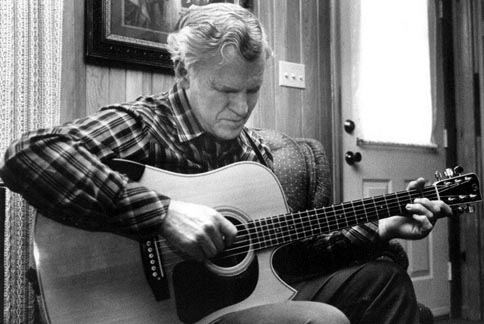
Doc Watson - The Best of Doc Watson: 1964-1968, Riding The Midnight Train (1986), Portrait (1987), Remembering Merle (1992), Docabilly (1994), and Del Doc & Mac (1998). Watson, blind since he was a baby, plays old-time folk and country with the speed and soul of a swing jazz guitarist. Watson's a great singer, too, with a rough and mournful edge in his voice that brings his songs on over. His first album came out in 1964, when Doc was already in his 40s. The first album here is a selection of tracks from the first 6 Watson albums, all produced for the Vanguard label. His son Merle joined him as his accompanyist starting with his second album in 1965. Merle played on subsequent Doc Watson albums for the next 20 years, but he was tragically killed in a tractor accident in 1985. Riding The Midnight Train was the last album that Merle played on, but Doc honors his son's memory every year with the extraordinary Merlefest bluegrass festival in Wilkesboro, NC. So, the music. I prefer the earlier material to the later albums, although the collection Remembering Merle, which features some of the best collaborations between the Watsons, is amazing, too. Docabilly is a rare departure for the man, featuring him playing electric guitar on a bunch of old rockabilly tunes (with Junior Brown on steel guitar!). But, nice as it is for the man to step out of his comfort zone, it ain't such a great album. Del Doc & Mac is a collaboration with Del McCoury and Mac Wiseman, and it sounds like a bunch of elderly masters of their genre having fun goofing around together, which is exactly what it is.


Dock Boggs - Country Blues: The Complete Early Recordings (1927-1929) and His Folkways Years, 1963-1968. One of the sources for Doc Watson's style, Boggs was a coal miner who recorded a few hillbilly records on his banjo in the 20s that sold moderately. Harry Smith uncovered them in the 50s and included them in his massive Anthology of American Folk Music, which spurred the folk resurgance of the early 60s, which gave the world Bob Dylan and Doc Watson, among others. Anyway, Boggs had pawned his banjo during the Great Depression, and didn't play again until 1963, when he bought a new banjo for himself only a month or two before the folk music anthologist Mike Seeger tracked him down. Seeger convinced Boggs to start playing for people at folk festivals and to record for the Folkways record label. These albums include everything Boggs recorded in the two phases of his music career. The Early Recordings is a Revenant release, which means that it's exquisitely documented and includes a few similar tracks for context. In this case, the context is provided by four recordings from Bogg's contemporaries Bill and Hayes Shepherd. The Folkways Years compiles the tracks from the three Folkways albums Boggs made throughout the 60s. Oh, and the music: Boggs sounds like the voice of hard living looking squarely down at Hell and knowing that's where he's heading and being torn between fear and unconcern. He's one of the most harrowing folk artists out there, but he's also a lot of fun to listen to. When you don't feel like killing yourself, that is.


----
Catch-up!


Bob Dylan - New Morning (1970), Blood On The Tracks: New York Sessions (1974), and No Direction Home: The Soundtrack (The Bootleg Series Vol. 7) (2005). New Morning is an album that I coveted when I went through the Dylan albums a few months ago. It's one of the few new Sony albums on eMusic that I was excited about, so I downloaded it. And I'm glad I did, because it's wonderful. Blood on the Tracks: New York Sessions is a bootleg that features all of the original versions of the songs on Blood on the Tracks, which were originally recorded in NYC with Phil Spector producing. Concerned that the album was too monotonous, Dylan went to Minneapolis and re-recorded about half of the songs: "Tangled Up In Blue," "You're A Big Girl Now," "Idiot Wind," "Lily, Rosemary, and the Jack of Hearts," and "If You See Her, Say Hello." So half of these songs were on the completed album. And three of the unreleased versions ("Tangled Up In Blue," "Idiot Wind," and "If You See Her, Say Hello") were included on the first Bootleg Series box set. So there's only two new tracks on this bootleg. I'm going to keep them and delete the rest. No Direction Home: The Soundtrack is another eMusic Sony album, and includes the incredibly rare music from the Scorcese documentary plus some more unreleased material that the archivists found, although it didn't make it into the movie. Great for Dylan fanatics!


Bonnie "Prince" Billy & Matt Sweeney - Superwolf (2005). Sweeney is all over the place, fronting the band Chavez and recording with Zwan, Guided By Voices, Cat Power, Johnny Cash, Andrew W.K., Six Organs of Admittance, El-P, and the Dixie Chicks, among others. He's also been in the touring band for Will Oldham (aka the Bonnie Prince) for a number of years. On this album, the two collaborate to produce one of the strongest and most rocking albums in Oldham's repertoire.

The Moviegoer, Part III: May - June 2009

This is Part 3 in our 6-part series of documenting the entertainments I have consumed in 2009! Here's what I have watched over the last two months:

63. Rached Getting Married: A
64. Torn Curtain: B
65. Real Life: A+
66. Forbidden Planet: A-
67. Star Trek: B+
68. My Neighbor Totoro: A+
69. Mon Oncle Antoine: B+
70. Salesman: A
71. Milk: B+
72. Role Models: B+
73. Fast, Cheap & Out Of Control: A-
74. Up: A
75. She Wore A Yellow Ribbon: B+
76. Theremin: An Electronic Odyssey: B+
77. Hour Of The Wolf: B
78. Directed By John Ford: B
79. Castle In The Sky: A
80. Fury: B+
81. After The Thin Man: B+

I also finished reading Rick Perlstein's Nixonland, a book that I started last fall and had to return to its owner just as Nixon was elected President at the halfway point. I found a copy used and put all else on hold while I read it. And read it. And read it. Either I've gotten to be a much slower reader or that was a seriously long book. But it didn't read like a seriously long book. In fact, time seemed to breeze away while I was reading it. It has the breathlessness of a political thriller, which, in some ways, it is. Highly recommended.

Having finished Nixonland, I turned my reading attention back to Faulkner's The Hamlet, which I was enjoying before I interrupted to re-read and finish Nixonland. I'd never read this one before (well, bits and pieces that showed up as short stories in some classes), but it's quickly becoming a favorite. Faulkner's clearly having a lot of fun. The subject matter isn't as weighty as any of the Compson books or Go Down, Moses, but the writing is gorgeous, and Faulkner's intellect and keen sense of story keeps it humming along at a good clip.

After this, I have a few other books piled up to read, but I'm especially looking forward to Jeff Roesgen's 33 1/3 book on the Pogues' Rum, Sodomy, and The Lash and William Bolitho's Murder For Profit, an out-of-print book from the 20s about serial killers that came highly recommended by Leonard Pierce.

Thursday, July 02, 2009

Music Library: Dirtbombs, Dirty Three, Distant Seconds, Dixie Chicks, Dizzee Rascal, Dizzy Gillespie, DJ Shadow, DJ Shortkut


The Dirtbombs - We Have You Surrounded (2008). The first album I've heard by this band, which has apparently been around for a while. And I like it more than I thought I would at first, although it's definitely a spotty album. It's garage-y, but it has some depth that's not immediately apparent.

Dirty Three - Dirty Three (1995), Horse Stories (1996), Ocean Songs (1998), Whatever You Love, You Are (2000), She Has No Strings Apollo (2003), and Cinder (2005). Calm on the surface, raging seas beneath. My favorites are Horse Stories and Ocean Songs, but they're all lovely in their own way. Or maybe in the same way. There's a definite progression in the albums, but the changes are minimal, and I've only noticed them when listening to the albums end-to-end like this. Cinder, with the focus on short songs and the guest vocalists Cat Power and Sally Timms, is the most radical departure, and it's my least favorite, too.

The Distant Seconds - We're Holding Out For Less (2007) and Spectral Evidence (2008). One of the best Austin bands going right now, the Distant Seconds favor lean, rhythmic songs with slippery basslines and skronky keyboards over minimalist guitar and solid, tricky drumming. There's a certain Spoon-ness at play, but the Distant Seconds have their own identity and sound. Great, great stuff.

Dixie Chicks - "Bring It On Home To Me." A Dale Evans cover, I think?

Dizzee Rascal - Boy In Da Corner (2003). I like Spank Rock's glitchy beats and weird flow, but didn't realize that they were invented by Dizzee Rascal, since I'm the last person on earth to hear this album. My friend Gary gave me a copy back in the fall. I listened to it a couple of times then, and not again until yesterday, but it's utterly amazing, and that's all I have to say on it.

Dizzy Gillespie - "Ool-Ka-Yu," Body & Soul (with Sarah Vaughan, 1949), and Duets (with Sonny Rollins and Sonny Stitt, 1957). I met Gillespie one time, towards the end of his life. It was early in the morning and he didn't have much to say, but I'm proud that I got to shake his hand. Prouder than this meager selection would indicate. Body & Soul barely has Sarah Vaughan on it, but it does have a few live tracks with some surprising scat singing. Duets is from the same recording session as the excellent Sonny Side Up album, and features Dizzy jamming with each of the two sax giants.

DJ Shadow - Endtroducing (1996). An album composed entirely of samples, Endtroducing was an incredible undertaking that still retains its power to astonish.

DJ Shortkut + Roy C Hammond - "Impeach The President." Takes you right back to 2005!

The eMusic eRevolution Will Be eHalf-Assed

Yesterday eMusic began offering the Sony catalog to subscribers, and incidentally screwed over many of the same long-term subscribers. Here's what happened.

At the end of May, the eMusic CEO Danny Stein announced that eMusic had inked a deal to offer some of the Sony catalog to subscribers. This led to two changes:

  1. New plans with less value for our dollar. Long-term subscribers were forced into new plans with fewer downloads for the same price per month. Some of these subscribers had plans that eMusic had grandfathered some years earlier. My former plan, for instance, was one I first bought in October 2005 for 90 downloads for $20/month. At at least one point afterwards, eMusic had modified their $20/month plan to include fewer downloads, but had allowed me to keep my plan. My new plan, however, is 50 "downloads" (I'll get into why I put scare quotes up in a minute) for $20/month. So my downloads have gone from 22.2 cents each up to 40 cents each. Still a better deal than Amazon or iTunes, but the effective cost to me has gone up by nearly 100 percent.
  2. Album pricing. Some - but not all - albums with more than 12 tracks will now have a fixed price of 12 "downloads," a term that eMusic has changed to "credits" on some pages. Some albums with fewer than 12 tracks, especially those where at least one of those tracks is longer than 10 minutes, will now cost subscribers 12 "credits" to download. This really hurts in metal and jazz, where the bang for the buck has always been so valuable. For example, I had 4 Albert Ayler albums in my Save For Later list, each of which had 2 tracks per album. Now eMusic wants 12 credits for each. It's still a better deal than Amazon or iTunes, but a far worse deal than I was offered just the day before yesterday.

So I spent the evening going through the new Sony offerings. I should point out that this wasn't easy, because eMusic's website remains as clunky and unfriendly as ever. The only way to find out what eMusic had added from Sony was to scroll through the new pages, which list everything recently added in groups of 10. All the Sony additions were made on 6/30/09, and to go through them all, I scrolled through nearly 900 pages. Some of the additions are damn great (Skip Spence, the Clash, Dylan) and some aren't (wow, the whole Celine Dion catalog plus Kenny G plus the New Kids On The Block, oh my!). The thing is that like many of eMusic's long-time subscribers, I'm already a hardcore music collector and I already have most of the new additions that I would be inclined to buy. I ended up adding a few Dylan albums that I don't have to my list, plus some Ellington and Mingus albums. I expect that it will take me maybe 2-3 months to burn through all of the new additions that interest me. At least, at the rate of my newly enhanced plan.


Judging from the 1600+ comments on Danny Stein's original announcement on eMusic's blog, I'd say that I'm not alone in being less than impressed with what subscribers are getting in return for the new catalog and reduced-value plans. I understand that eMusic needs to do what it can to remain a viable business, and Stein said that eMusic had been under pressure from the indie labels for some time to increase its per-download charge. I don't like the suddenness of the change, nor the lack of a response to complaints from eMusic. It is as if they've decided that they don't care about keeping their often-enthusiastic long-time subscribers - or, at least, don't know how to show that they care - and that doesn't make much business sense to me.


eMusic also needs to figure out what the per-album pricing means to them and to customers. If many of the albums I was previously planning to download now will cost me either 12 or 24 credits (double-albums are twice the credits), why are all the monthly download plans and booster packs being offered in multiples of 5? Don't get me wrong: I prefer the base-10 idea, but why not make the per-album credit a flat 10 downloads, then? Not that eMusic would listen to me; I'm merely a long-time subscriber.

My photo
Cary, NC, United States
reachable at firstname lastname (all run together) at gmail dot com

About This Blog

From Here To Obscurity, founded ca. 2003, population 1. The management wishes to emphasize that no promises vis-a-vis your entertainment have been guaranteed and for all intents and purposes, intimations of enlightenment fall under the legal definition of entertainment. No refunds shall be given nor will requests be honored. Although some may ask, we have no intention of beginning again.

  © Blogger templates Brooklyn by Ourblogtemplates.com 2008

Back to TOP