Monday, April 20, 2009

Music Library: Can in the Studio

Can is Stockhausen and funk and VU-style garage-art and psychedelia and jazz and god knows what else. Easily one of the all-time greatest bands in rock music, Can is about the sound of inner space, which is the original name of the band and the name of their homebuilt studio.

Studio Can:

  • Monster Movie. Hear the band struggle against the prevailing sound of garage-psych, seeking to create the motorik-based krautrock we have all come to know and love! The only official studio album from the band's run with Malcolm Mooney on vocals, Monster Movie features three great attempts to create an entirely new approach to rock and "Yoo Doo Right," the first example of the Can aesthetic: monster riffage built around throbbing bass and driving drums, running on for nearly 20 minutes.
  • Soundtracks. This one is a collection of tracks recorded for films between 1968 and 1970. A couple of these tracks feature Mooney on vocals, but most feature their new vocalist, the electrifying Damo Suzuki. The standout tracks are the last two: "Mother Sky," one of the rockingest tracks in Can's ouevre, and "She Brings The Rain," a more meditative and jazzy track.
  • Tago Mago. Oh my, yes yes. This album starts in a paper house on fire and then the world goes up in a huge mushroom cloud. And that's only the first 10 or so minutes. Then there's the cheerful/wistful "Oh Yeah" and the most monsterous of monstrous bass riffs "Halleluwah." And that's just the first disc. Disc two has "Aumgn," which never fails to give me the creeps, "Peking O," which is extradimensionally bizarre, like funk for centipedes or something, and "Bring Me Coffee Or Tea," which provides a lovely little coda to the album. I've found that this album is particularly well-suited to provide the soundtrack to Murnau's Nosferatu.
  • Ege Bamyasi. The title means "Aegean Okra" in Turkish. This is Can's most accessible album from their high period, featuring a higher ratio of short, catchy songs to noisy, experimental sonic soundscapes. If you don't know if Can is for you, this album should be your litmus test. What's good on this album? Everything. "Vitamin C" and "Spoon" are probably my favorite individual Can tracks, but the way they work with the album as a whole is a revelation.
  • Spoon 7". "Spoon" is the single, but the b-side is "Shikako Maru Ten," which sounds like what it is: an outtake from Ege Bamyasi.
  • Future Days. This is Damo Suzuki's final album with Can, and a beautiful example of how the Can aesthetic could incorporate the appeal of their catchy, hook-laden singles with the more experimental noise-and-funk and meld it all into a four-song, 41-minutes magnum opus that seems to be about the sound and texture of water, wrapped in an allegory about time. Some of the music on this is so utterly gorgeous that it's hard to believe it was made by mere humans. The water analogy is particularly apt, as much of the music has a surface tranquility that is belied by the constant churn of Jaki Liebzeit's motorik drumming and Holger Czukay's pulsating bass.
  • Soon Over Babaluma. With Damo Suzuki gone, guitarist (and violinist, at least on this album) Michael Karoli and keyboardist Irmin Schmidt took over the vocals. This is the last great Can album, sadly. After this, the band's pop impulses took them to some ugly places. Their commitment to inner space begat a commitment to superficial dance music with radio transmissions. But this album sees The Can working their magic all the way through, and god bless 'em for that.
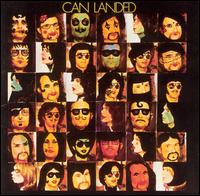
  • Landed. This is the last Can album I can bring myself to pick up. "Vernal Equinox" and "Unfinished" are the standouts, but after listening to the greatness of their prior albums, Landed sounds even more insubstantial than usual. It's not terrible, though. Just half-assed. I generally enjoy the tracks when they pop up on the ipod, so I think they sound better out of the context of the greatness of prior Can. But MAN, "Vernal Equinox" is one of those tracks like Elvis Costello's "Last of the Lipstick Vogue," where you can hardly believe that a rhythm section could play that fast and accurately and still rock like crazy.
  • Delay 1968. Some leftover tracks with Mooney intended to be their first album Prepared To Meet Thy PNOOM. Apparently this was rejected by a few record companies, which led the band to work on the tracks that would become Monster Movie. This is definitely on the more psych-garage side of things, so hooray for the record companies for pushing Can to do better. That said, it's an interesting document of where Can was coming from.
  • Can Box Music. This is an album from the Can Box with examples of Can's fascinating live improvisational style. You know what? I'm going to be discussing Live Can in the next Music Library post. I'm going to hold off on this until then.

At The Screengrab: The Hemingway Night

Forgot to mention a review I wrote about a great short movie at the Screengrab last week. The Hemingway Night! Check it out should the opportunity arise.

Breaking Bad

Dear creators of Breaking Bad,

You amaze me. Just wanted to mention that.

Friday, April 17, 2009

Music Library: Califone + Camper Van Beethoven

Califone - Quicksand/Cradlesnakes. Lovely album of indie-aesthetic Americana with random noise bursts. Reminds me a bit of the Centro-Matic spinoff South San Gabriel and a bit of Sparklehorse, which is one of my favorite bands. It's never grabbed me as much as either of those bands, though. I should give it more time.

Camper Van Beethoven:

  • Telephone Free Landslide Victory. An enormously great debut album with CVB's blend of Americana, Eastern European fiddle tunes, Beefheartian jaggery, post-punk DIY smartassery, and the aching sincerity underlying silly-on-the-surface songs like "The Ambiguity Song" (refrain: "Everything seems to be up in the air at this time.") This title includes my original copy of the album, plus mp3s of the bonus tracks from the re-release in 2004. The bonus tracks are from EPs around the time and are mostly utterly dispensable. But the album itself is near-perfect, like most of CVB's catalog.
  • Live at the I-Beam June 2, 1986 (bootleg). I'm not sure why I keep this around, outside of my immense affection for CVB. The name of the later official live album Greatest Hits Played Faster says it all.
  • II & III. My least favorite of the original CVB releases, this one plays up the instrumentals and smartassery and feels like the one with the least depth. This rip is from the 2004 re-release which, like the other re-releases, messes up the flow by inserting the bonus tracks into the heart of the album itself. I could re-arrange it, but I've never bothered to.
  • Third Album/Vampire Can Mating Oven. There's three different albums captured here. The original s/t Camper Van Beethoven, usually called The Third Album, is here in its entirety. There's also the bonus tracks from the 2004 re-release. And there's the EP Vampire Can Mating Oven, which was appended onto my CD copy of the Third Album. All of those tracks appear again on Camper Vantiquities. And the music is CVB at their most experimental and awe-inspiring. I'd go through the highlights, but there's not a wasted moment on this album, even including the backwards fiddle tune "Stairway To Heavan (sic)." My favorite may be "The History of Utah," which tells a mythologized story about Joseph Smith and mixes it with sudden personal observations, all set to a casually psychedelic musical progression from blues through several different parts. Their cover of Pink Floyd's "Interstellar Overdrive" is a revelation, too.
  • "Guitar Hero." From a flexidisc for Bob magazine, this instrumental pops up again on Camper Van Beethoven Is Dead as "Closing Theme."
  • Greatest Hits Played Faster. A live album that delivers on the promise of its name.
  • Our Beloved Revolutionary Sweetheart. A more pop-oriented effort (that's relative, mind you) that retains the CVB psychedelia and lyrical trickiness that leaps from surreal to heartfelt without pausing for breath. Particularly great are the first four tracks: the first two "Eye of Fatima" songs, the reworking of the traditional bluegrass track "Oh Death," and the heavily psychedelic "She Divines Water," although this album is brilliant, start to finish.
  • Key Lime Pie. Sometimes this is my favorite album. It's CVB's most naked appeal for a larger audience, but it's still far too weird to even approach the possibility, at least for 1989. The lyrics seem to be based on the conceit of "The History of Utah," floating around American history with a definitely mythological bent. "When I Win The Lottery," about a down-and-out guy dreaming of what he would do with his winnings, should be the national anthem. Great, great stuff, and newly available on iTunes. Here's a jokey blogpost I wrote about the album for Powell's Books on the 4th of July last year.
  • Camper Vantiquities. A rarities compilation. I don't have the tracks from the re-release. Should do something about that.
  • Camper Van Beethoven Is Dead: Long Live Camper Van Beethoven. Another rarities album, this one from years later. Includes some remixes and new tracks from the classic CVB lineup.
  • Live at the Great American Music Hall 2002 (bootleg). From the time when the band began playing again. This bootleg features nearly 3 hours of music. I think CVB were happy to be a going concern again.
  • Tusk. A track-for-track remake of the Fleetwood Mac album undertaken by the CVB members in the early 00s to see if they could work together again. Not the best thing they've done, but surprisingly touching in parts.
  • New Roman Times. A 2004 concept album from the reformed CVB about a civil war in the US between Texas and California. Weird and sometimes wonderful stuff, but not up to the greatness of their original run of albums.

Wednesday, April 15, 2009

Music Library: C.W. McCall, Caetano Veloso, Caitlin Cary, Cake, Calexico

Onwards into the Cs!

C.W. McCall - "There Won't Be No Country." Classic country that doesn't really stand out.

Caetano Veloso - Caetano Veloso [1967], Caetano Veloso [1971], Prenda Minha, and "Haiti." Veloso's career spans many tumultuous decades. He's been called the Bob Dylan Of Brazil, but that sort of diminishes him, makes him seem like a shadow of a different guy. And Veloso's definitely his own man. I was fortunate enough to read his autobiography Tropical Truth a few years ago, which discusses his role in the tropicalia movement, being exiled from Brazil in the early 70s, and his comeback. The first two albums I have are from the tropicalia period. They are also the first and third of his five self-titled albums. That's right; he out-self-titled Peter Gabriel, and he started a decade prior. The second of these is mostly in English, recorded while in exile in London. It's also a lot more, well, in turns sultry and bizarre, especially with all the odd effects-laden vocal noises. Prenda Minha is a live album from the late 90s, and it covers a lot of different styles from Veloso's career, including tropicalia, weepy bossa nova, reggae-influenced funk, and other sounds I don't really have a name for. "Haiti" is also live, but the song itself was Veloso's contribution to a 1993 25th-anniversary compilation of tropicalia artists.

Caitlin Cary & Ryan Adams - "The Battle." S'okay. No Depression stuff.

Cake - "Nugget." Not a fan.

Calexico:
  • Spoke. Most of that kitchen sink desert-rat sound is right here from the start.

  • The Black Light. This one pulls the drawstring tight. Americana-mariachi-Morricone-jazz-noir.

  • 98-99 Road Map. Live concert-only album.

  • Descamino EP. Heavy on the fake jazz, light on the fun stuff.

  • Hot Rail. This is my favorite of the classic Calexico albums.

  • Travelall. Another tour-only album, heavy on the instrumental Morricone-ish fake jazz, but much better than Descamino.

  • Aerocalexico. Live tour-only album.

  • Crystal Frontier EP. More a single than an EP.

  • Even My Sure Things Fall Through EP. Now that's an EP. Pretty good!

  • A Feast of Wire. The last of the great classic Calexico albums.

  • Scraping. Live tour-only album.

  • Alone Again Or EP. Four song EP built around the Love cover it's named for.

  • Quattro EP. Yet another four song EP.

  • Garden Ruin. Ugh. Calexico made the worst Whiskeytown album.

  • Carried To Dust. An attempted return to form. Not bad, but not great, either.

Monday, April 13, 2009

Music Library: Butthole Surfers, Buzzcocks, Byrds

Last three B bands! And they all kick ass!

The Butthole Surfers:

  • Brown Reason To Live/Live PCPPEP. The first two BS releases. You can hear them working towards the classic Butthole Surfers sound.
  • Psychic... Powerless... Another Man's Sac. I sure love this album. I know it's not quite up to the insanity that the Surfers were about to unleash over the next three albums, but this one hit me at just the right age.

  • Cream Corn From The Socket Of Davis EP. An early taste of the mature (that can't be the appropriate word, can it? Let's say fully-formed) Butthole Surfers sound.

  • Rembrandt Pussyhorse. The sound of taking too many hallucinogenic drugs among a bunch of terrifying people you don't really know. This is the sound of being far outside of anyone's safety zone and having no idea where the brakes are. This is the crazy punk-ass homegrown psychedelia your mother warned you about.

  • Locust Abortion Technician. Or this is. (And this is the best one, for the record.)
  • Hairway to Steven. Or this.

  • Piouhgd + Widowermaker!. This is not. There's moments of pure Butthole Surfer awesomeness here and there, but for the most part, Pioughd is D.O.A. Even in a song like "Revolution Part II, " which is at least 47% awesome, there's a kind of overdetermined weariness that stands in sharp contrast with the unhinged craziness of prior albums.
The Buzzcocks - Time's Up, Another Music In A Different Kitchen, Love Bites, A Different Kind of Tension/Parts 1, 2, 3, Singles Going Steady. I thought about splitting these out to talk about each album on its own, but I'm not sure how specific I can get about each album's greatness. Time's Up is, of course, the Spiral Scratch EP with Howard DeVoto on lead vocals, plus a few extra demos, including a cover of Beefheart's "I Love You, You Big Dummy." If you just know the Buzzcocks from the perfect pop-punk progenitor Singles Going Steady, you might be surprised by the Can and Neu! influences on their studio albums.

The Byrds - The kings of American folk-rock that turns into psych-rock that turns into sweet country-rock. Here's how their albums (at least the ones I have, and I should really pick up the rest) play out:

  • Mr. Tambourine Man. Folk-rock in its purest form.

  • Fifth Dimension. Leaping into psychedelia with "5D" and "Eight Miles High," but retaining their folk-rock fundamentals. Beautiful stuff.

  • Younger Than Yesterday. The Byrds leap antennae-first into acid-drenched psych rock without abandoning their commitment to gorgeous multi-part harmonies.

  • The Notorious Byrd Brothers. A more insubstantial effort, somewhere between confident psych-rock and unsure floundering.

  • Sweetheart of the Rodeo. Ground Zero for country-rock. Gram Parsons joined the Byrds and pushed them forewards by going backwards to the country records of his youth. This release has bonus tracks of the songs with Parsons on lead vocals. On the actual release, Parsons had to be erased due to legal troubles with chamber-popster Lee Hazlewood, and McGuinn gamely did his best Gram Parsons impression for the final released tracks. Great, great, great album.

At The Screengrab: DVR-worthy movies this week

The Grand Illusion, Living In Oblivion, The Maltese Falcon, Paranoid Park, and the Hidden Fortress. Click the link to find out when!

Friday, April 10, 2009

Music Library: The Bunch, Burial, Butch Hancock

The Bunch - Rock On. This is the sound of a young Richard and Linda Thompson doing a bunch of rockabilly and country covers with a number of other Brit-folk luminaries, including Sandy Denny and Trevor Lucas. Best track: Linda Thompson (as yet unmarried to Richard, so listed as Linda Peters) duetting with Sandy Denny on the Everly Brothers' "When Will I Be Loved?"

Burial - Untrue. Not really my thing, but I don't hate it, either. This is an electronica album (dubstep, they call it) filled with moody synthesizers, heavily reverbed and digitally manipulated vocals, and skittery rhythms. If I had heard it before I got it from eMusic, I wouldn't have downloaded it. I was really just curious about the near-universal accolades. And it sounds to me like the kind of music that would be blaring at an expensive haircut shop or hip thrift store, which doesn't really feel all that necessary.

Butch Hancock - Own and Own. This is a best-of by the folkiest (Woody-est?) of the Lubbock crew. Hancock is a West Texas songwriter (and a member of the Flatlanders, along with Joe Ely and Jimmie Dale Gilmore) with a penchant for a clever turn of phrase and a powerful emotional undercurrent running through his songs.

My photo
Cary, NC, United States
reachable at firstname lastname (all run together) at gmail dot com

About This Blog

From Here To Obscurity, founded ca. 2003, population 1. The management wishes to emphasize that no promises vis-a-vis your entertainment have been guaranteed and for all intents and purposes, intimations of enlightenment fall under the legal definition of entertainment. No refunds shall be given nor will requests be honored. Although some may ask, we have no intention of beginning again.

  © Blogger templates Brooklyn by Ourblogtemplates.com 2008

Back to TOP